This post has been long in the making, its birth finally inspired by the plight of a fellow velo-bloggerist - whose story I will use as a case study here. Taking care to keep her identity hidden, I shall refer to my fellow velo-bloggerist as "Dee".
 [image: "Dee" rides cargo trike]
Case Study: Dee and Her Search for "The Bike"Dee lives in the suburbs. She rides an enormous cargo trike, in which she carts around two children, groceries, drycleaning, sleds, and whatever else the day might bring. Being young, fit and vivacious, Dee hungers for a personal bike - one she could ride on her own with joyful abandon. Her husband agrees that she must have such a bike, and a reasonable budget has been allocated. All seems rosy ...until Dee tries to decide what bike to get. Let's see, what are her criteria? She wears mainly dressy clothing, she plans to ride the bike in all seasons, and she always carries a bag when she is out and about. An upright sitting position, internal gear hub, enclosed hub brakes, a chaincase, and a good basket set-up would be ideal.
 ["Dee" completes triathalon]
But wait. Dee also dreams of going on longer, zippier rides on this bike, in hilly areas. Perhaps try touring some time. She wants to keep up with her husband when he is on his carbon fiber road bike. She wants speed when she feels like it. And did I mention she has completed a triathalon? All this brings a different bike to mind: derailleur gearing, handlebars that allow for a variety of hand positions, lighter weight.
If you know about bikes, you can already see the problem here. The two "ideals" for the different styles of riding she plans to do, are in conflict with one another. The heavy loop frame, North Road handlebars and the internal gear hub that will protect Dee's ivory silk trousers as she pedals elegantly to her meeting in town, will not get her up hills alongside her husband's roadbike. Likewise, the sporty geometry and derailleur gearing that will allow her to glide uphill on those long rides, will not be kind to her dressy outfits once she is back to her town life. Not to mention that derailleur gearing is a pain to maintain in the winter season, and the caliper brakes that come with sporty bikes do not work as well in poor weather as enclosed hub brakes. As Dee shops around, goes on various test rides, and continues to weigh her criteria, she realises that she cannot have both sets of features on the same bike. What is she to do?
 ["Dee" wears elegant duds]
Here is a list of what, in my view, are the options available to a person in Dee's position:
A. Recognise that you need two bicycles rather than one: you need a city bike and a sporty bike. Adjust your budget, your manufacturer(s) of choice, or your purchasing timeline accordingly.
B. Determine what kind of cycling you will be doing most: city or sporty? Based on this, buy a bicycle that is ideal for that type of cycling, recognising that whenever you will be doing the other type, you will be riding a less than ideal bike and it may be difficult.
C. Try to find a bicycle that you see as the best possible combination of some city features and some sporty features.
Based on anecdotal evidence, my impression is that many people in Dee's position are naturally drawn towards Option C. Option A seems financially prohibitive. Option B seems scary, because it involves accepting that you will not be able to do some of the things you want to do on the one bike you're getting. Option C appears to make sense: It seems like a sensible idea to get a bicycle that lets you do some of this and some of that.

However, I think that Option C is often a mistake, and that those who choose it may ultimately be unhappy. A bicycle that has
some city features and
some sporty features is not "the best of both worlds" as we wishfully think, but rather, a compromise. Let's say Dee finds a bicycle with upright geometry and derailleur gearing. A comfortable bicycle that can handle hills, right? Well, yes, that sounds reasonable. But what about riding it in the city wearing those flowing silk trousers? And what about caring for that derailleur in the winter? During times like these, Dee will be wishing she'd gotten a "real" city bike. And what about those long rides, when her hands will begin to go numb because of the North Roads' limited hand positions? Well, during times like those she'll be wishing that she'd gotten a "real" sporty bike.
Essentially, "kind of good for both" means ideal for neither. That is my main caveat against buying "compromise bikes", especially if you plan to spend a great deal of money on the bicycle and rest all of your hopes and dreams on it.
While at first glance it might not seem possible that you can afford Option A, there are most definitely ways to do it. One suggestion, is to buy the dominant bicycle (for the style of riding you will be doing most) new, and the supplementary bicycle (for the style of riding you will be doing less of) vintage. This is the route I went when I bought a new Pashley for the city (retail price: $1200) and a vintage Motobecane for sporty rides (typical C-List price: $150). The extra cost of the Motobecane was marginal, but my needs were pretty much satisfied between those two bikes. A year later, you can save up and upgrade by replacing that second vintage bike with a new bike, if you feel that's necessary.

The main point that I hope to bring across here, is that the idea of that one bike that is perfect for every kind of cycling is a fiction - a dream that's as futile to chase as our own shadow. There is no such thing as the perfect bicycle, only the perfect bicycle of its kind. Versatility is good, but there is a fine line between versatility and compromise. It is up to you to decide where that line lies.


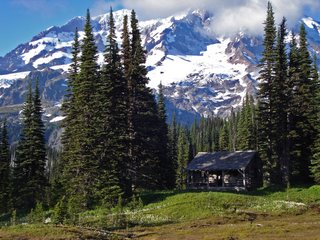 The snowpack is rapidly melting, which allows for quick and easy access to the alpine. Most of the Wonderland Trail, for instance, has melted out (save Panhandle Gap area.) The meadows are in full bloom, yet the upper mountain still has a fair amount of winter snowpack. Time to climb...
 Cycling is great exercise, and exercise leads to weight loss - if (and this is a crucial if) all else remains constant. In other words, if you used to drive to work and now you cycle, while maintaining the same diet as before and the same amount of physical activity outside your commute, you will lose weight.
  But what happens when that amount of daily cycling becomes unsustainable - due to either the arrival of a harsher season, travel, or a change in work schedule? Once you get used to consuming large amounts of food, it can be extremely difficult to cut down, even after your level of physical activity decreases. The reasons for this are partly physiological (stomach size; metabolic processes), but to an even greater extent psychological. We use food not just for sustenance, but for comfort and for social bonding. Having grown used to eating pizza and ice cream late at night with friends, it can feel sad to give that up. Once we grow accustomed to a lavish diet during a period of intense cycling, chances are we will be tempted to maintain it even during those times when we do not spend as much time on a bike. This can lead to an overall weight gain for those who cycle.
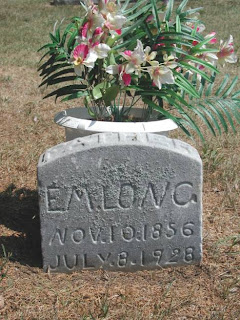
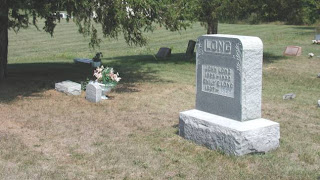 The Long family plot at Salem Cemetery, Washington Township, Noble County, Indiana.
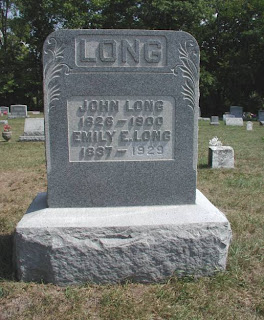 JOHN LONG / 1826 - 1900 / EMILY E. LONG / 1837 - 1929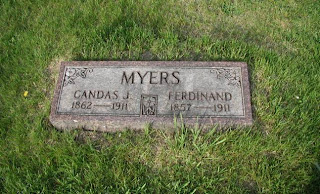
 As you have probably noticed, I own more than a couple of bicycles at this point. I have also sold a fewand may be paring down further before the summer's end. Most of the bicycles I've owned have gone through a variety of experimental alterations - some minor, others major; some successful and others not so much. So, what is the point of it all? Were some of these bicycles "mistakes" that I should not have gotten in the first place? And are my various projects ultimately wastes of time and money if I end up selling the bicycle in the end?
 Bicycle ownership for me has two purposes. First and foremost, it is utilitarian: Ideally, I want to own several bicycles, each of which will excel at a designated function - such as commuting or cyclotouring. But I also enjoy learning about different kinds of bicycles. This includes understanding bicycle history, geometry, positioning, and the differences between manufacturing styles. And I would argue that this kind of knowledge can only truly be gainedthrough owning and riding a variety of bicycles; just reading and chatting about it is not sufficient. For me, bicycle ownership has been educational, and no bicycle I have acquired and subsequently let go of has been a "mistake": They have each helped me understand something crucial.
 Some things I have learned through my experiences:
 Though there have been frustrations, there have also been great rewards. The Pashley Princess was a dear fried whose beauty inspired me, and thanks to whose stability and reliability I immediately became comfortable with vehicular cycling. The Raleigh Lady's Sportstaught me all about vintage English 3-speeds, plunged me into anobsession with cream tires,and, ultimately, made me realise that I prefer loop frames to straight step-through frames. And the Mercier mixte helped me understand derailleur gearing by allowing me to boldly experiment with drivetrain conversion, as well as to experience an authentic French city bicycle from a bygone era.
 As I have already mentioned, Vienna has a fairly well developed bike share programme:
  For a tourist who wants to explore the center of Vienna by bicycle, Citybike is great. It also works for locals who both live and work in the city center. Sadly, I work in an area of Vienna that is not covered by the Citybike network and there are no stations near my office. In order to commute to work and back, I would have to rent the bicycle for the entire day, which would be financially prohibitive: The rental costs are calculated on a sliding scale, where the first hour is free, but the second hour is 1 Euro, and subsequent hours are priced increasingly higher. According to this scale, it would cost me 30 Euro per day to commute to work and back - which would of course be madness.
 Even to go for a short recreational ride before or after work is not an option, because the bike's basket does not accommodate my work bag.
 This is the bag I carry to work when I am in Europe. It contains my laptop and the documents I need for the day. As you can see, it does not fit in the basket - and since it's a one-shoulder bag, cycling with it in traffic is not something I want to do. This bag goes with me to official meetings, and switching to a messenger-style bag would not be appropriate in my line of work. I think that any city implementing a bike share programme must take this factor into consideration. In my view, it is a design flaw when professionals are unable to use the bicycles because the basket will not accommodate a standard laptop-sized bag. As you can see below, there is no rear rack either.
 For those who want to cycle in the center of Vienna as tourists, the Citybikes are certainly well fitted for this purpose: step-through frames with adjustable saddle height; swept-back handlebars for an upright sitting position, dressguards, a chainguard,
 fenders and mudflaps,
 non-slip pedals,
 a wide saddle with springs that is probably fine on short rides,
 and the newer Citybikes have 3 speeds, which is sufficient for the central (non-hilly) parts of Vienna.
 An additional reason I do not rent Citybikes is that, frankly, I do not wish to turn myself into a mobile billboard. In the photo above, you can see the juxtaposition of the Citybike moto "Vienna for free!" (this refers to the first hour of rental being free of charge - though there is still an initiation fee of 1 Euro) and the yellow adverts for